LedgerScan Technology Overview
LedgerScan is a massive scale, ledger agnostic, data processing engine that collects and stores specified blockchain data off chain for enrichment, normalization and to provide near real-time analytics and reporting. See LedgerScan Overview for more information on the functional capabilities and related use cases of LedgerScan.
The fundamental architecture of LedgerScan calls for an off-chain record of all transactions of interest retrieved from one or more blockchain ledgers. This design overcomes the significant performance issues inherent in blockchain data access, allowing for LedgerScan to be deployed for high performance operations, such as near real-time support for 24*7*365 valuation of assets.
LedgerScan comprises several key components and makes use of others that also support Securrency’s Capital Markets Platform. For a full list of components, see Securrency Components.
For the most part, LedgerScan-related components run in a Google Cloud Platform environment. An architecture schematic is presented below:
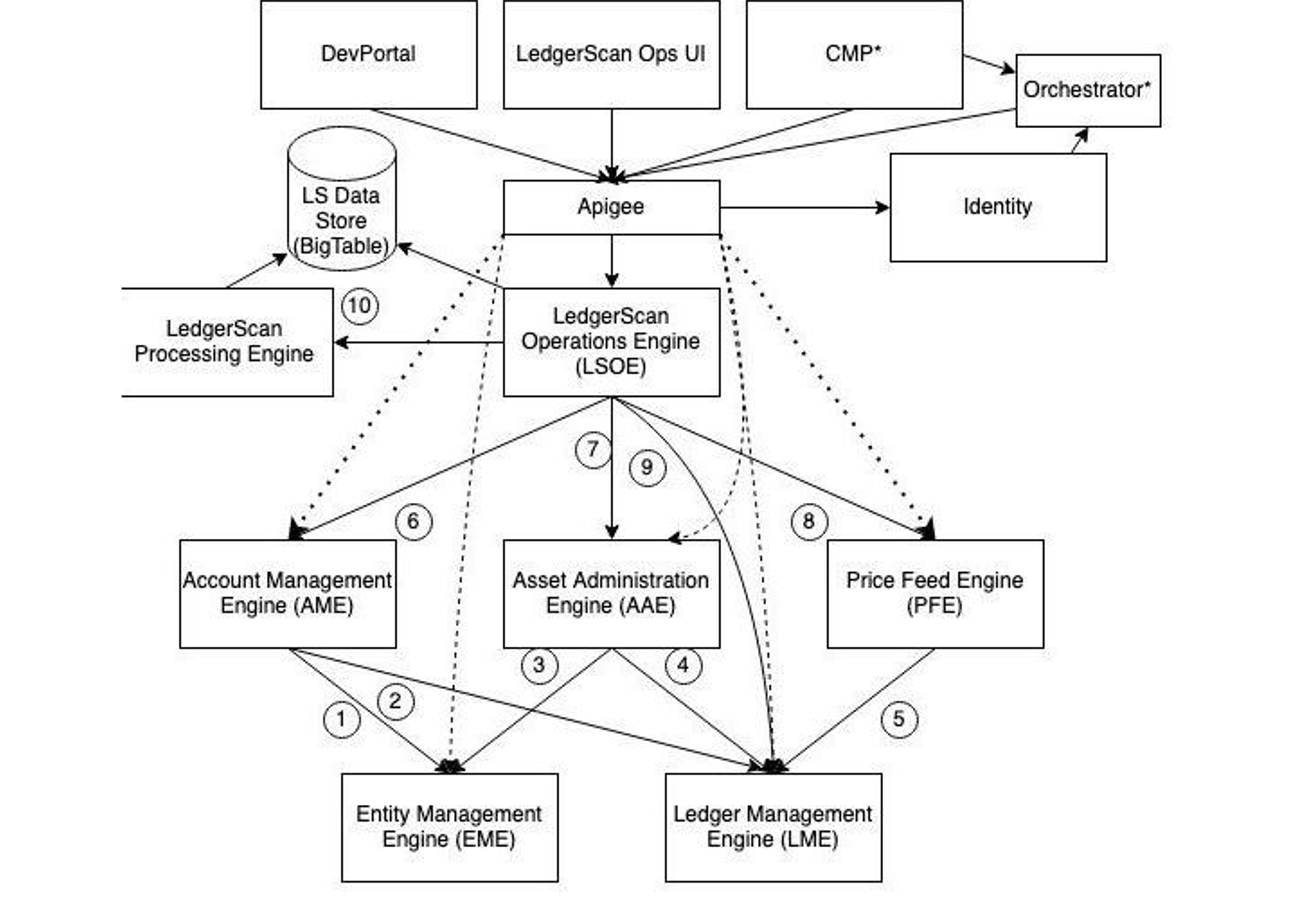
Referring to the above architecture, key components are noted below, along with important interactionss.
Apigee - a Google product for API monetization.
Ledger Management Engine (LME) - responsible for all CRUD (Create, Read, Update, Delete) operations on all blockchain ledgers. Interfaces with several components as per diagram above - (2), (4), (5) and (9).
LedgerScan Data Store - a massive-scale time series NoSQL database used to store data retrieved from distributed ledgers and other sources. Implemented using the Google Cloud Platform BigTable database.
LedgerScan Operations Engine (LSOE) - aggregates API endpoint calls/data from various components (PE, AAE, AME, LSPE, BigTable). Interfaces to several components as per diagram above - (6), (7), (8) and (9).
LedgerScan Processing Engine (LSPE) - monitors distributed ledgers for pre-defined events and retrieves them to populate the LedgerScan Data Store.
Other components that are required in order for LedgerScan to deliver its capabilities are:
Account Management Engine (AME) - manages the user account to distributed ledger wallet relationship. As per (1). the AME makes account information available to the EME. And in (2), wallets are assigned to ledgers via the LME.
Asset Administration Engine (AAE) - manages digital asset creation and heirarchies. As per (3), tokens are assigned to entities via the EME. Also, tokens are assigned to ledgers via the LME.
Entite Management Engine (EME) - manages entity (human and corporate) and relationships between them.
Identity - manages user and application access to LedgerScan
Pricing Engine (PE), aka Price Fee Engine (PFE) - receives near real-time pricing data from external sources, and maintains a Price Store database for historical pricing. When an external source is a DEX marketplace, a distributed ledger is assigned via the LME as per (5).
The various functions provided by the above components are available to users and/or administrators via the LedgerScan Operations Portal.
API access to the above components is also available, but developers need to understand the process flows and sequences required to make API endpoint calls. These are documented in the Securrency Developer and Documentation Portal.